


In late payments, elegy
In all forgery, effigy
In things forgotten, surgery
In things whispered,
Nick the Lich
I was in Islington that autumn when the rain never stopped quite and the streetlights turned everything a faded ambrotype. Late nineties. When people still carried cash in their pockets and the clubs stayed open until the first orange blush of light leaked under the doors. I had come over for reasons I rapidly outgrew. A flat in a converted warehouse off Upper Street. The sort of place where the radiators clanked at irregular intervals and the windows rattled whenever a bus passed. I kept the lights low. It suited the work I was pretending to do.
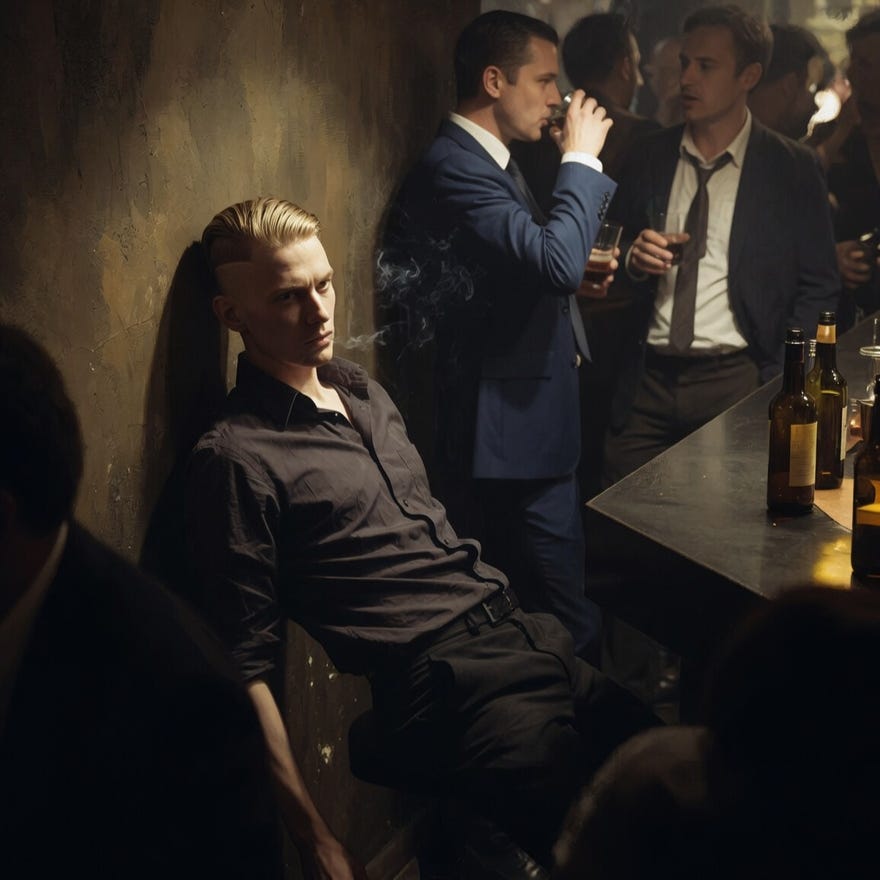
He moved between tables the way other men might move between rooms in a house they had once owned. It goes like this, he said. It goes like this. That was the phrase he used the first time I noticed him. He said it without smiling. He said a great many things without smiling. I watched him from the banquette near the back where the velvet had worn thin at the edges. The bar was called the Fox and Hounds then or perhaps it had already changed its name. Names shifted in those places. So did the men who carried them.
He wore a leather jacket the color of wet slate, under it a black T-shirt that had been washed too many times. His hair was cropped close at the sides and longer on top. He had a scar above one eyebrow that caught the light whenever he turned his head. I never asked about the scar. Questions like that were not encouraged.
He shifted between tables. Between floors. Between worlds. He would lean in close to a man at the bar and speak softly. Then he would be at a table by the window pulling a wallet from the inside pocket of a coat left draped over a chair. The gesture was so fluid it looked rehearsed. Credit cards. Driver’s licenses. Small folded notes. All of it in plastic sleeves with raised ridges that caught the light like Braille. He examined each item under the table as if reading a private letter. Then he replaced everything exactly as he had found it. Or almost exactly. That was the art of it.
Oh excuse me he said once when our eyes met across the room. I don’t mean anything by it he said. His voice was low and carried the faint trace of somewhere else. Manchester perhaps. He pulled one wallet then another from the leather jackets from the coats that hung on the backs of chairs. It goes like this he said. In late payments. In elegy. In all forgery. In effigy. In things forgotten. In surgery. In things whispered.
The words stayed with me the way certain songs do. Not because they made sense but because they arranged themselves into a rhythm that matched the low throb of the music coming from the back room. House tracks. The kind that repeated a single phrase until it became incantation. Nick the Lich they called him. Not to his face. Never to his face. The name had something to do with the way he could make things disappear and reappear without anyone noticing the change. A credit limit altered by a single digit. An address updated in careful block letters. A photograph swapped for one that looked almost identical. The kind of forgery that required patience rather than skill.
I sat there most evenings with a glass of warm white wine and a notebook I rarely opened. The rain beat against the windows in irregular bursts. Outside taxis hissed through puddles on Highbury Corner. Inside the air smelled of cigarette smoke and spilled beer. There was also the particular sweetness of amyl nitrate that drifted from the toilets in waves. Men danced in the small space between the bar and the DJ booth. Others stood in clusters near the door checking their reflections in the mirrored panels behind the optics. Everyone was waiting for something. Or pretending not to.
He came over once and sat down without asking. He placed two wallets on the table between us. One was black leather worn smooth at the corners. The other was a cheap nylon thing with a Velcro flap. He opened the first and slid out a driving licence. The photograph showed a man in his thirties with a serious expression and a tie that had gone out of fashion two seasons earlier. He studied it for a long moment.
It goes like this he said again. In late payments. In elegy. He closed the wallet and pushed it across the table toward me. Keep it he said. The man won’t miss it until tomorrow. By then the numbers will have changed. I did not take it. He shrugged and slipped both wallets back into the inner pocket of his jacket. The gesture was so casual it might have been lighting a cigarette.
I asked him why he did it. Not out of moral concern; I wanted to hear the answer in his own words. He looked at me for a long time. He said people carry their lives in their pockets. They think the plastic and the paper and the raised ridges make them real. They think if they keep the receipts they can prove they were here. But the receipts are just paper. The cards are just plastic. One good night and none of it adds up anymore.
He said this without bitterness. That was the strange part. There was no anger in him. He had an acute attention to the way things came apart. The same attention I had once tried to bring to other places. Other proposals. He understood entropy the way some men understand engines. He could see the moment when the balance shifted.
Later that same night I watched him work the room again. He moved between tables. Between floors. Between worlds. He would brush against a man on the stairs and come away with a credit card tucked into his palm like a playing card. He would stand at the bar and order a drink with money taken from someone else’s coat. The barman knew him. Everyone knew him. No one ever said anything. It was part of the arrangement. The night had its own rules. They were fragile and they changed with the weather.
I thought about the flat I kept in the warehouse. The radiator that clanked at three in the morning. The way the light came in gray and diffuse even on the rare days when the rain held off. I thought about how easy it would be to slip one of those cards into my own pocket. Not to use it. Simply to see what happened when the numbers no longer matched the name.
He caught me watching again. He came over and sat down. He pulled another wallet from his jacket. This one was brown calfskin. Expensive. He opened it and showed me the photograph inside. A man and a woman on a beach somewhere. The man had his arm around her shoulders.
He said this one I keep. The rest I put back. He closed the wallet and placed it on the table between us. It goes like this he said. In late payments. In elegy. In all forgery. In effigy. In things forgotten. In surgery. In things whispered.
I did not ask what he meant by surgery. I understood it had nothing to do with hospitals.
Outside the rain had eased into a drizzle. The streetlights still blurred. A group of men in leather jackets stood smoking under the awning of the club. Their laughter carried across the pavement. They were young. Or they had been young not long ago. Time moved differently in those rooms. It stretched and contracted according to the music and the amount of cash left in your pocket.
He stood up. He adjusted the collar of his jacket. He said he had one more table to work before closing. He did not say goodbye. He never did. He simply shifted between tables. Between floors. Between worlds. The phrase stayed with me long after he had gone. It described the way the entire city felt that autumn. Everyone moving through versions of themselves that overlapped but never quite matched.
I left the brown wallet on the table. Someone else would find it. Or it would disappear into the lost property box behind the bar. Either way the numbers inside would no longer add up by morning. That was the situation. That was how the night ended. Not with drama but with the small specific adjustment of a single digit. The kind of change no one notices until the statement arrives in the post and the address on the envelope belongs to someone else entirely.
I walked back to the flat through the rain. The radiator was clanking again. The windows rattled.
The city kept moving outside. Taxis. Buses, the No. 43. Men in leather jackets heading home or not heading home. I sat at the table by the window and opened my notebook for the first time in weeks. I wrote down the words he had repeated. Late payments. Elegy. Forgery. Effigy. Forgotten things. Surgery. Whispered things. I did not try to make them into a story. Stories were what people carried in their wallets. I simply let the words sit there on the page the way the rain sat on the glass. Rain drops catching the light for a moment. Then they did not.